
If your business depends on customers in your immediate area—and let’s be honest, most do—then local SEO isn’t a nice thing to have. It’s paramount and the engine that drives foot traffic, phone calls, and revenue. Yet, most businesses still don’t have a local SEO strategy in place. That’s a problem for them, and an opportunity for you.
I’ve spent years helping businesses across industries—from healthcare providers to home service contractors to law firms—build local search visibility that translates into real business growth. The strategies in this guide aren’t theoretical. They’re the same ones I implement for clients every day, backed by the latest data from Whitespark, BrightLocal, and Google’s own documentation.
This guide covers everything you need to rank in local search in 2026: Google Business Profile optimization, citation building, review strategy, local link building, on-page local signals, and the emerging role of AI in local results. Whether you’re running a single-location shop or managing a multi-location brand, this is your roadmap.
Let’s get into it.
Why Local SEO Matters More Than Ever
The numbers tell the story. Over 1.5 billion “near me” searches happen every month, and 76% of people who search for something nearby on their phone visit a business within the same day. That’s not casual browsing. That’s high-intent traffic looking to spend money.
Here’s what makes local search so powerful compared to traditional organic SEO: the people searching already want what you sell, and they want it nearby. An 80% conversion rate on local searches—meaning 4 out of 5 local searches result in a purchase—makes this the highest-ROI channel most businesses aren’t fully exploiting.
The local pack (that map section at the top of Google’s results) now captures 44% of all clicks in local search, with organic results picking up 29% and ads trailing at 21%. If you’re not in that pack, you’re invisible to nearly half of your potential customers.
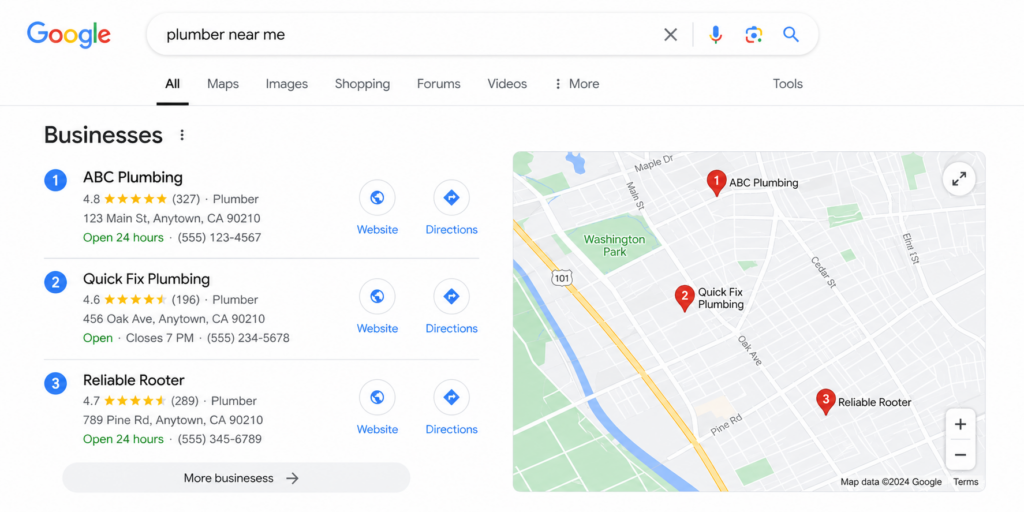
The Google Local Pack dominates search results for location-based queries, capturing 44% of all clicks.
And the landscape is shifting. The 2026 Whitespark Local Search Ranking Factors report highlighted a few things I’ve been watching closely: behavioral signals (like mobile clicks, dwell time, and click-to-call actions) are gaining ground, review signals are more influential than ever, and Google now factors in whether your business is open at the time of search. That last one caught a lot of people off guard, but it makes sense—Google wants to send searchers to businesses that can actually help them right now.
The Core Local Ranking Factors You Need to Understand
Google’s local algorithm comes down to three pillars: relevance, distance, and prominence. Every tactic in local SEO maps back to one of these. Understanding them isn’t optional—it’s the foundation everything else builds on.
Relevance
Relevance measures how well your business matches what someone is searching for. Your primary Google Business Profile category is the single strongest signal here. If you’re a personal injury attorney but your primary category is just “Lawyer,” you’re telling Google you’re less relevant for personal injury searches. Category selection matters more than most people realize.
Beyond categories, the keywords in your GBP services, your website content, and your reviews all feed into relevance. When a customer writes a review mentioning “emergency roof repair” and that’s a search term you’re targeting, Google connects those dots.
Distance
This one is straightforward—Google evaluates how close your business is to the person searching. You can’t game proximity. What you can do is make sure your address is accurate, your service areas are properly defined, and your location pages are dialed in for the neighborhoods you actually serve.
Here’s a misconception I see constantly: expanding your service area settings in GBP does not increase your ranking radius. It doesn’t work that way. What does help is building genuine local signals—reviews, citations, content—for each area you serve.
Prominence
Prominence asks: “Is this business trustworthy and established?” Review quantity is the primary signal. You don’t need a thousand reviews to start ranking, but hitting the 10-review threshold triggers a measurable ranking boost. Businesses in the top three local pack spots have an average of 561 Google reviews and a 4.8-star rating—that’s not an accident.
Backlinks from locally relevant sites (your Chamber of Commerce, local news outlets, community organizations) also feed prominence. So does brand search volume—when people search your business name directly, Google sees that as a trust signal.
Google Business Profile Optimization
Your Google Business Profile is the single most important asset in local SEO. Businesses with complete, accurate GBP listings get 7x more clicks than incomplete ones. A verified profile receives roughly 200 interactions per month—clicks, calls, direction requests. That’s not traffic you can afford to leave on the table.
I’ve written a detailed deep-dive on this topic in How to Optimize Your Google Business Profile for Maximum Visibility, but here are the elements that move the needle most.
Get the Basics Right
- Choose your primary category carefully. This is the strongest relevance signal in local search. Don’t pick a generic category when a specific one exists.
- Fill out every field—business hours, services, attributes, products, description. Businesses with complete profiles are 50% more likely to be considered for purchases.
- Upload high-quality photos consistently. Businesses with photos get 42% more direction requests and 35% more website clicks.
- Keep your hours accurate—especially holiday hours. Google now considers whether you’re open at the time of search as a ranking factor.
Use GBP Features That Most Competitors Ignore
Google keeps rolling out new GBP features, and most businesses ignore them. That’s your advantage. Products, services with descriptions, Q&A (seed it with your own frequently asked questions), and regular Google Posts all send engagement signals that influence rankings.
One thing I tell every client: treat your GBP like a social media profile, not a set-it-and-forget-it directory listing. Weekly posts, fresh photos, responding to every review—this level of activity signals to Google that your business is active and engaged. And it makes a real difference in rankings.
Local Citations and NAP Consistency
A citation is any online mention of your business name, address, and phone number (NAP). Think Yelp, Yellow Pages, industry directories, local Chamber of Commerce listings. Citations help Google verify that your business is legitimate and located where you say it is.
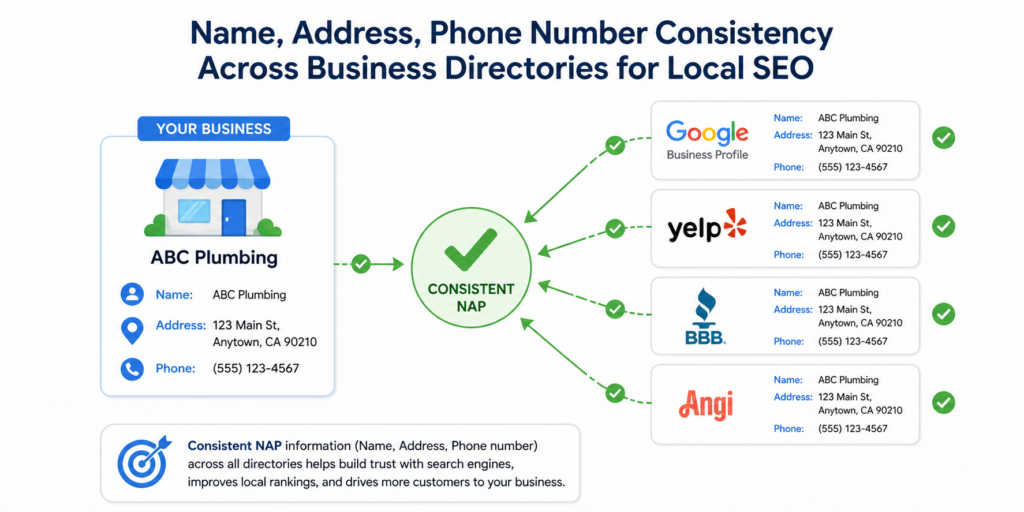
NAP (Name, Address, Phone Number) consistency across all online directories is a foundational local SEO signal.
The critical thing with citations isn’t volume—it’s consistency. If your business name is “Horton Digital” on Google but “Horton Digital LLC” on Yelp and “Horton Digital Marketing” on the BBB, that inconsistency creates confusion for search engines. 62% of consumers will avoid a business if they find incorrect information online.
For a complete walkthrough on building and managing your citation profile, check out Local Citation Building: The Complete Strategy for Small Businesses. The short version: start with the big aggregators (Data Axle, Localeze, Foursquare), then work through industry-specific and local directories. And audit your existing citations at least twice a year to catch and fix inconsistencies.
The Citations That Actually Matter
Not all citations are created equal. Here’s the priority order I use with clients:
| Priority | Source Type | Examples |
|---|---|---|
| 1 – Essential | Data Aggregators | Data Axle, Localeze, Foursquare |
| 2 – High Impact | Major Platforms | Google, Apple Maps, Bing Places, Yelp, Facebook |
| 3 – Industry | Niche Directories | Avvo (legal), Healthgrades (medical), Houzz (home services) |
| 4 – Local | Community Sources | Chamber of Commerce, local newspapers, community sites |
Reviews: The Most Underrated Ranking Factor
I’ll say it plainly: reviews are the conversion engine of local SEO. They’re ranked as the #1 factor for conversion impact by Whitespark’s 2026 study, and they’re the sixth most important factor for local pack visibility. When a business improves its rating from 3.5 to 3.7 stars, conversion rates can jump by nearly 120%. Small changes create outsized results.
For the full playbook on building a review strategy, head over to How to Get More Google Reviews (and Why They Matter for Rankings). But here’s what matters most:
Review Velocity Over Review Volume
Getting two new reviews every month is far more valuable than getting 20 reviews in one burst and then going silent for a year. Google’s algorithm looks at review velocity—a steady stream of fresh reviews signals an active, relevant business. One of the first things I audit when working with a new client is their review timeline. If there’s a six-month gap with no new reviews, that’s a red flag for rankings.
Respond to Every Review
Every single one. Positive reviews deserve a genuine thank-you. Negative reviews require a thoughtful, professional response. Review responses aren’t just customer service—they’re an SEO signal. Google has confirmed that responding to reviews improves your local search visibility. And for potential customers reading those responses, how you handle criticism says more about your business than any marketing message ever could.
Make It Easy for Customers
The number one reason businesses don’t get more reviews is they don’t ask. Create a direct review link from your GBP, include it in follow-up emails, text it to customers after service calls. Remove every friction point. The ask should be simple, timely, and specific: “We’d really appreciate a Google review about your experience with [specific service]. Here’s the direct link.”
On-Page Signals for Local Search
Your website needs to do two things well for local SEO: tell Google exactly where you are and what you do, and give visitors the information they need to choose you over a competitor. Here’s how to nail both.
Location Pages That Actually Rank
If you serve multiple areas, you need dedicated location pages—not thin, template-swapped pages where you just replace the city name. Google’s algorithm (and your visitors) can see right through that. Each location page should include:
- Unique content about your services in that specific area
- Local landmarks, neighborhoods, and geographic references that show genuine familiarity
- Customer testimonials from clients in that area
- An embedded Google Map with your business location
- LocalBusiness schema markup with accurate NAP data
I cover this in depth in How to Create Location Pages That Rank in Local Search. The key takeaway: think like a local, not like a marketer. If your page about “Plumbing Services in Aurora” could apply to any city without changing a word, it’s not going to rank.
Schema Markup Is Non-Negotiable
Structured data is how you speak directly to search engines and AI systems. LocalBusiness schema on your homepage and every location page tells Google your business name, address, phone number, hours, services, and service area in a format it can parse instantly. It’s also the native language of AI Overviews—and with 40% of local business queries now triggering AI Overviews in search, you need your structured data locked down.
For the technical implementation details, see our guide on Technical SEO. At minimum, every local business should implement LocalBusiness schema, Review schema (to display star ratings in search), and FAQ schema for common service questions.
Title Tags and Meta Descriptions With Local Intent
Every service page and location page should include your target location in the title tag. Not stuffed—natural. “Emergency Plumber in Austin, TX | 24/7 Local Service” tells both Google and the searcher exactly what they’ll find. Your meta description should reinforce the local angle and include a clear reason to click.
Local Link Building Strategies
Links from locally relevant websites are one of the most powerful ranking signals for local SEO. Businesses in the local map pack average 993 backlinks and 216 referring domains—those numbers aren’t achievable overnight, but they show the competitive bar you’re working toward.
We go deep on this topic in Local Link Building Strategies That Actually Work. Here are the highest-ROI tactics:
Community Involvement
Sponsor local events, youth sports teams, charity fundraisers, or community organizations. These almost always come with a backlink from the event or organization’s website. It’s genuine community participation that happens to carry SEO value—the best kind of link building.
Local Media and PR
Pitch stories to local newspapers, TV stations, and community blogs. Seasonal angles work well (“How to Winterize Your Home” from an HVAC company, “Tax Season Preparation Tips” from an accounting firm). Local journalists are always looking for expert sources, and each mention typically includes a link back to your site.
Strategic Partnerships
Cross-promote with complementary local businesses. A real estate agent and a home inspector. A wedding venue and a caterer. A dentist and an orthodontist. Guest posts, co-hosted events, and reciprocal links with businesses that share your audience but aren’t direct competitors.
AI Overviews and the Future of Local Search
Here’s what’s changing fastest in local search: AI. Google’s AI Overviews now appear in over 40% of local business queries, and the trend is accelerating. AI chatbots like ChatGPT and Perplexity are increasingly pulling local business data from Bing, Apple Maps, and structured data sources to answer local queries directly.
What does this mean for your local SEO strategy?
- Structured data is more important than ever. AI systems read schema markup to understand your business. Without it, you’re invisible to AI search.
- Cross-platform presence matters. Optimize not just Google, but Apple Business Connect and Bing Places. ChatGPT often uses Bing for local data.
- Content quality wins. AI Overviews tend to cite well-structured, authoritative content. Thin pages with swapped city names won’t get cited. Deep, genuinely helpful content will.
- Track AI visibility. Start monitoring how often AI platforms mention or recommend your business. This is becoming a meaningful metric alongside traditional rank tracking.
I’m tracking these trends closely and will be covering them in more detail in an upcoming post on how AI is changing SEO for business owners. For now, the takeaway is simple: do local SEO well, and you’ll be well-positioned for AI search too.
How to Measure Local SEO Performance
Vanity metrics won’t pay the bills. Here’s what you should actually be tracking:
Primary Metrics
- Local pack rankings for your target keywords in your target locations. Use a grid-based rank tracker to understand your actual visibility radius.
- GBP actions: calls, direction requests, website clicks. These are the high-intent interactions that lead directly to revenue.
- Organic traffic from local keywords: filter your Google Analytics data to isolate traffic from geo-modified and “near me” searches.
- Conversion rate from local traffic: form submissions, phone calls, appointment bookings. Track these with goal tracking or call tracking software.
Secondary Metrics
- Review velocity: how many new reviews you’re getting per week or month. Steady growth signals a healthy local presence.
- Citation accuracy: periodic audits to ensure your NAP is consistent across all platforms.
- AI visibility: are AI search tools recommending your business? This is emerging as a key metric for 2026 and beyond.
For more on building an effective reporting framework, see our SEO Reporting Best Practices page. The goal is connecting every SEO activity to a business outcome—not just ranking positions, but leads, calls, and revenue.
Local SEO Mistakes I See Constantly
After auditing hundreds of local businesses, these are the issues that come up over and over:
- Choosing the wrong GBP categories. Most businesses either pick something too generic or miss secondary categories entirely. This single fix has moved businesses from page two to the local pack.
- Ignoring reviews. Not asking for them, not responding to them, and not having a system for it. Reviews are the #1 conversion factor—treat them accordingly.
- Duplicate or inconsistent citations. Old phone numbers, wrong addresses, or business name variations across directories. This erodes trust with Google.
- Thin location pages. Template pages with nothing but a swapped city name. Google can tell, and so can your potential customers.
- No local link building strategy. Relying entirely on directories when your competitors are earning links from local media, organizations, and partnerships.
- Neglecting mobile experience. 57% of local searches happen on mobile. If your site is slow or hard to navigate on a phone, you’re losing those 88% of searchers who visit or call a business within a day.
Your Local SEO Action Plan
If you’re starting from scratch or looking to overhaul your local presence, here’s the sequence I recommend:
- Claim and fully optimize your Google Business Profile. Nail your categories, complete every field, upload photos, and post weekly.
- Audit your citations. Find and fix inconsistencies in your NAP across all directories and platforms.
- Build a review generation system. Make asking for reviews a part of your operational workflow, not an afterthought.
- Implement LocalBusiness schema. On your homepage and every location/service page.
- Create (or rewrite) your location and service pages. Make them genuinely local, not template-swapped.
- Start local link building. Community sponsorships, local media outreach, and strategic partnerships.
- Set up tracking and reporting. Rank tracking, GBP insights, conversion tracking, and monthly review audits.
- Expand to Apple Business Connect and Bing Places. Cross-platform presence matters more every year.
The Bottom Line
Local SEO in 2026 isn’t fundamentally different from what it was five years ago—the core principles of relevance, trust, and proximity still apply. What has changed is the competitive bar. More businesses are investing in local search, AI is reshaping how results are served, and Google’s algorithm is getting better at distinguishing genuinely local businesses from those just gaming the system.
The businesses that win at local search aren’t the ones with the biggest budgets. They’re the ones that show up consistently—in their GBP, in their reviews, in their content, and in their community. That’s always been true, and it’s not changing anytime soon.
If you’re looking for a partner to build or refine your local SEO strategy, schedule a free consultation with Horton Digital. We’ll audit your current local presence, identify the highest-impact opportunities, and build a roadmap tailored to your business and market.
Continue Reading
This post is part of our Local SEO hub. Explore the related guides:
- How to Optimize Your Google Business Profile for Maximum Visibility
- Local Citation Building: The Complete Strategy for Small Businesses
- How to Get More Google Reviews (and Why They Matter for Rankings)
- Local Link Building Strategies That Actually Work
- How to Create Location Pages That Rank in Local Search
Frequently Asked Questions
How long does local SEO take to show results?
Most businesses start seeing measurable improvements in local pack visibility within 3-6 months of consistent optimization. GBP changes (categories, photos, reviews) can impact rankings within weeks, while building citations and earning local links typically takes longer to compound. The timeline depends on your starting point, competition level, and how aggressively you implement changes.
Do I need a physical address to rank in local search?
You need a verified Google Business Profile, but you don’t need a visible storefront. Service-area businesses (plumbers, electricians, consultants) can hide their address in GBP and still rank in local results. The key is defining your service areas accurately and building local signals (reviews, citations, content) for those areas.
How important are reviews compared to other local ranking factors?
Reviews are the #1 factor for local conversion and the 6th most important factor for local pack rankings, according to Whitespark’s 2026 study. More importantly, they influence both rankings and customer decisions simultaneously. A business with strong technical SEO but poor reviews will lose to a competitor with good reviews almost every time.
What’s the difference between local SEO and regular SEO?
Local SEO focuses on ranking for location-specific searches (“dentist near me,” “best pizza in Denver”) in the local pack and maps. Regular organic SEO targets broader search visibility. Most local businesses need both, but local SEO delivers higher conversion rates because the search intent is more immediate and action-oriented. Learn more about our full SEO services to understand how they work together.
Should I hire an SEO agency for local SEO, or can I do it myself?
You can absolutely handle the basics yourself—claiming your GBP, asking for reviews, and keeping your information accurate. But the strategic pieces (competitive analysis, technical schema implementation, link building, ongoing optimization) benefit significantly from expert guidance. If you’re a small business owner already stretched thin, an agency lets you focus on running your business while the SEO work gets done consistently. Read more about when it makes sense to hire an SEO agency.
